


 Sep 12, 2025
 admin
adminHow AI Is Changing Keyword Research and Content Optimization
You go to look at your Google Analytics and see declining traffic again for the third month in a row. What gives? Business owners complain that fewer people now click through to their websites due to search engine features like AI Overview. Many with websites feel like their sites have become invisible. Truth is, a new shift has come to SEO, and if you don’t know how to pivot, you’ll get left behind. AI SEO keyword research is important now more than ever before.
Let’s explore how AI has been changing keyword research and content optimization, and how you can position your website to benefit from this seismic shift instead of becoming a victim of it.
The Rise of Zero-Click Searches and Their Impact on SEO
First, let’s take a look at what a zero-click search is. Zero-click searches mean that internet users can now ask questions and receive direct answers from Google. The user can stop at the search engine without the need to proceed to a website for answers. Common examples of zero-click searches include things like:
- Weather updates
- Basic facts
- Time conversions
- Mathematical formulas
You could, for example, ask Google a question like, “What’s the weekly weather forecast in Denver?” It would show you something like this below:
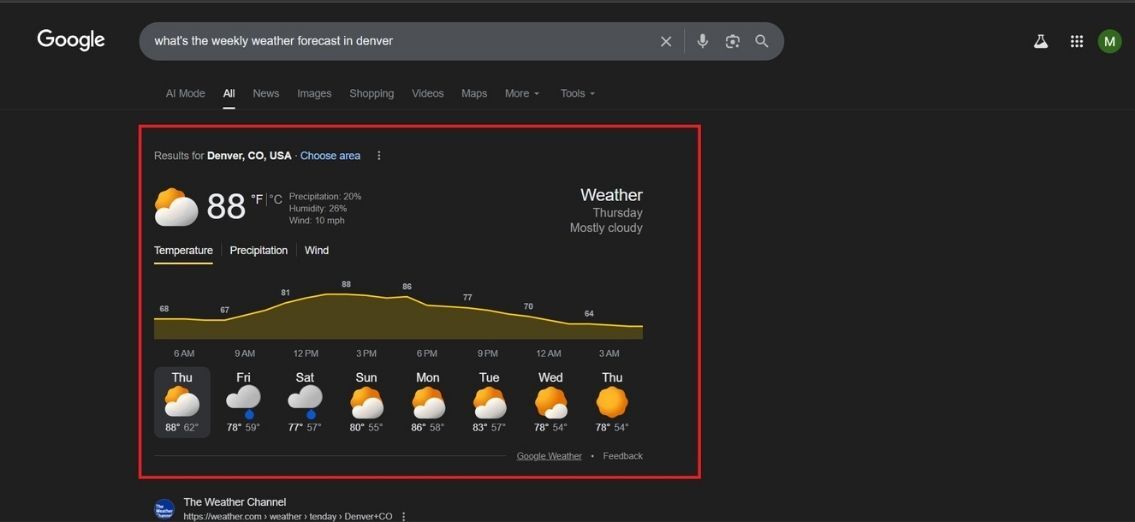
The average person will look at the weather at the top of the search results, which I highlighted in red, and will go no further than that. You call that a zero-click search because no one clicked into a website like The Weather Channel directly beneath the first result.
For basic answers, most users will see the first result on the search engine and need nothing more. Nowadays, you can rank for the top keyword in something and see little to no traffic from it.
You also have to check to see if the AI answers the question thoroughly, because if it does, you are likely targeting a zero-click keyword. Example of zero-click searches include:
- Featured Snippets
- AI Overviews
- AI Mode
- Direct Answer Box
- Local Pack
- Knowledge Panel
- People Also Ask
Business owners who largely target these types of keywords will sometimes see clicks to their website. The reason for it being that users can quickly get the information they need right from the search engine.
How Do You Survive Zero-Click Searches?
For many business owners, AI taking over the search engines sounds like a nightmare! For some, it has even been a nightmare with traffic falling from the sky. In truth, you can turn some zero-click searches into something if you understand how to optimize them. Let’s take a look at what you can do to pivot in this new era of search.
1. Target Keywords Effectively
Try to target keywords that don’t focus on zero-click search results. Here are a few signs that the keyword has less click potential, and you should target a different keyword:
- Direct and instant answers
- Large number of SERP features
- A single domain dominates the search
- High volume of paid ads
Before you choose a keyword to target, think about the ROI. To measure the ROI, you need to define your goals. What do you hope to achieve? Would you like to increase traffic to your website, increase your sales, increase your conversions, or grow in brand awareness?
Set these goals using clear key performance indicators (KPIs). You can use different analytics tools, depending on your goals. For example, Google Analytics, Google Search Console, and Hubspot can all measure and track some of your key metrics, such as traffic, bounce rate, conversions, click-through-rate, and dwell time.
Over time, look at if your metrics improved or became worse.
2. Forget About Volume
This highlights one of the ways that SEO has changed from the past. Before, you wanted to get as much traffic as you possibly could; even now, you still want as high of traffic as possible. However, AI SEO keyword research no longer credits growing traffic as the only measure of success.
Lower traffic that expresses interest in your products and services will yield more value than a ton of low-quality traffic and leads who are disinterested in your products and services.
This is where content optimization has begun to play an even more important role. When you attract traffic with zero interest in buying your products, you may as well not have had that traffic. The number may make you feel good at first until you realize how it doesn’t lead to your business growing or getting you closer to your goals.
There are reasons to be optimistic with AI SEO. Some business owners report AI SEO as helping them to get higher conversion rates from quality traffic since the people who click on their websites express a greater interest in buying. According to Semrush, the average LLM visitor is worth 4.4x what traditional organic search visitors were worth due to their conversion rate being an average of 16% from ChatGPT, compared to 1.8% from organic search sources.
3. Focus on Intent Instead of Keywords
Intent could be defined as what the users hope to find from their search. Instead of only looking at the keyword, you should now focus on AI SEO keyword research that also considers the intent behind the search.
People want answers to their problems quickly. The more direct you make your content, the higher your chances of getting cited in the AI search engines.
The intent is the modern SEO strategy and how SEO has evolved in 2025. Keywords are now only one part of the equation. When you look at intent, it should cover the following things:
- What should the content cover based on the intent of the user?
- What do the search results look like based on the keyword phrase?
- Choose the right content format.
- Adjust your language and writing tone based on the intent of the user.
- Make the meta tags reflect the search intent to increase your conversions.
Finally, you want to optimize your content to match the expectations or intent of the users to increase engagement.
4. Optimize Your Content
In the age of AI SEO keyword research, content optimization matters now more than ever. With the traffic that you draw to your website, you want to convert as many of them into leads as what you possibly can. Obviously, a high conversion rate was desirable even before, but it matters even more now due to AI taking large volumes of the traffic.
Some say that traffic coming from AI tends to convert at a higher rate, but you still need to optimize your content to get the best conversion rate.
Content optimization is a process where you add content, see how it performs, revise it and improve it, see how it performs, and revise it again. This process continues with you refining your content ongoingly. You keep doing this with the purpose of getting a higher conversion rate.
The goal is to keep improving the content. With higher performing pages, you typically want to optimize them every three to six months. Doing it this way gives the search engines time to look at your content and rank it to its fullest potential. With older content, you might update it every six months to a year.
Some of the things you’d look at when you optimize your content include things like:
- Content Structure: Clear and defined content structure is now more important than ever before in the age of answer engine optimization (AEO). You want it to have a logical structure, headers, subheaders, bullet points, italics, and numbered lists.
- Content Quality: Your content should demonstrate your expertise. Mention the pain points of your audience, and write answers to their questions in a direct way. Keep refining the content over time.
- Links: You want to include internal and external links to your content. Internal links tell the search engines that you have other related content. They connect the posts on your website making them more navigable. External links, on the other hand, provide users with extra value.
Best AI Content Optimization Tools
This shows you how to optimize your content, but I thought I’d mention a couple of content optimization tools to assist you. Some of the tools that I’ve used in the past for content optimization include:
- Semrush: The Content Optimizer from Semrush evaluates your drafts for SEO, readability, and tone. At the same time, it provides you with real-time suggestions to improve your score.
- Frase: When you use Frase, it can analyze the existing content to provide you with insights about adding keywords. You can check the readability score and improve it or use it to generate free content outlines.
- Clearscope: Many business owners use Clearscope to optimize their content by getting real-time feedback, and grading the content to refine your content until you can rank it as well as possible.
Can You Get Around AI Searches?
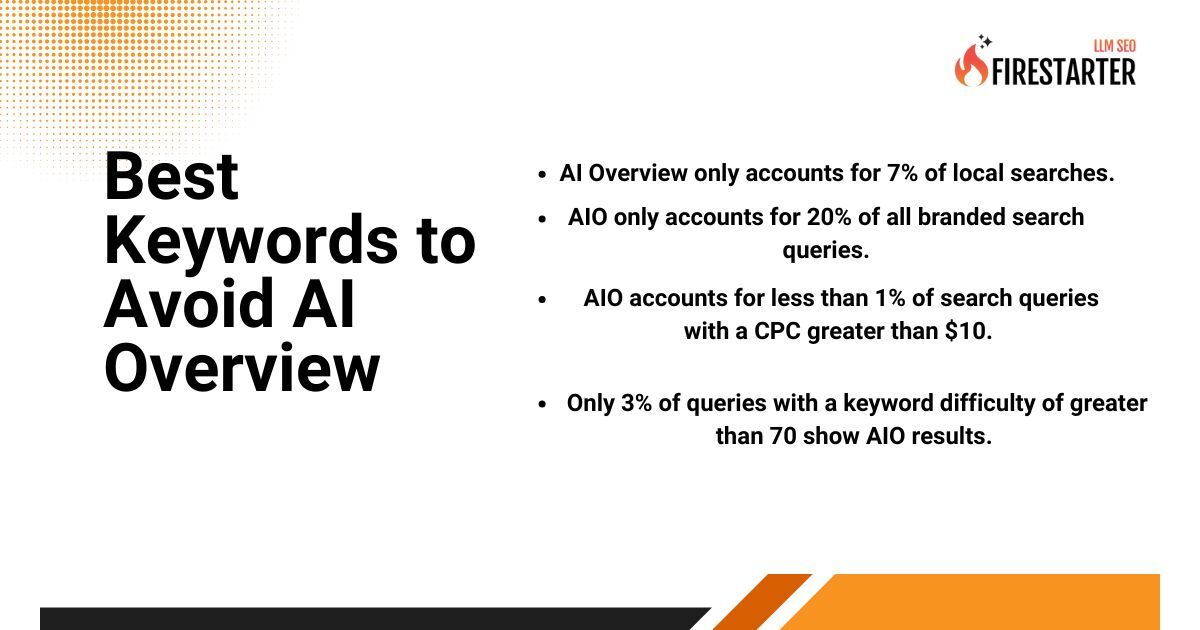
Now, AI SEO should be a part of your SEO strategy since it will likely grow more popular, but you may be wondering if there’s a way to get around the AI Overview feature. In fact, there are a few things you can do to avoid AI Overview keywords. Most of the keywords with AI Overview will be low cost-per-click (CPC), informational queries.
Here are some facts to keep in mind with some entire classes of keywords least likely to trigger the AI Overview:
Is Keyword Research Even Useful Now That AI is Taking Over?
Keyword research has changed, but it remains as relevant as ever. Google can’t get rid of keywords because it still needs to understand the intent of users. What has changed is now you need to understand intent. You must consider search behavior and the topic. Keyword stuffing has far less importance than before.
Also, optimizing your content is now more important than ever before to ensure that you get the highest conversion rate possible with the traffic to your website.
Conclusion
AI SEO keyword research is now more personalized, looking at your individual data to provide context. That’s one of the big ways that it has changed since AI came into play. It has also become harder to game the system. SEO hasn’t stopped just because of AIO and LLMs. What has changed is that the rules have changed compared to before.
If you still worry about visibility in the search results, check out the packages from Firestarter AI SEO. We can help you be seen in the search engines.